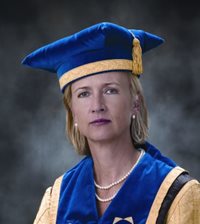
Santie Botha
Santie Botha was born on 5 August 1964 in Pinelands, Cape Town, and matriculated from JG Meiring High School in Goodwood.
Following her business nose, she completed a Bachelor’s degree in Economics at Stellenbosch University in 1985 and then did her honours degree, graduating in 1986.
She started her career at Unilever (a major global fast moving consumer goods business operating across more than 100 countries) in 1987 as a marketing graduate and worked for Unilever in various marketing and sales roles both in Durban, (four years) and London, UK (six years), culminating in the position of Commercial Sales Director of van den Berg Foodservice, UK, before returning to South Africa in 1996.
She then joined the ABSA Group as Marketing Director in April 1996 where she was charged with the overall marketing strategy and structure for the group as well as the implementation of new initiatives to dramatically change the business. During her time in this position she initiated and was instrumental in the successful merging and rationalisation of four retail brands with a brand equity of more than 400 years into one brand, ABSA. This was a first in the global financial services industry and enjoyed savings in excess of R1 billion across the business. Santie was the youngest person to be appointed to both senior management and the Absa Bank Board.
Moving up the corporate ladder, she was appointed as Group Executive Director of the ABSA Group in November 1998 with group strategy, e-Business and information management, marketing, card division and payment systems, corporate affairs and personal financial services all part of her extensive portfolio. She was also a member of the executive committee of ABSA Group, a board member of ABSA Bank and a member of the MasterCard AMEA Board (Africa, Middle East, Asia).
As Group Executive Director, she initiated, collaborated and implemented a new strategy and structure for the ABSA Group aligned with the segmentation approach and single brand strategy, launched its Free Internet Access in the South African market - a major first which catapulted the ABSA brand to the top 10 brands in the country after only three years.
Taking up a challenge in the mobile telephone industry, in July 2003, Santie joined the MTN group as Executive Director: Marketing. This included her serving as a member of the MTN Group Executive Committee as well as board director of MTN South Africa, MTN Cameroon & MTN Yemen.
Santie can be credited for MTN being regarded as the Top Mobile Brand in Africa both from a value as well as positioning perspective. She took charge of rebranding nine Investcom countries to MTN within 12 months of acquisition (from Afghanistan to Ghana). Another feather in her cap is the fact that MTN was the first African based company to become a Tier 2 Global Sponsor of the FIFA 2010 Football World Cup. She was part of the executive team which grew MTN’s business from six countries in 2003 to 21 countries in 2010, with over 140 million customers and R110 billion in revenue.
Santie left MTN at the end of 2010 to pursue her own and other business interests.
Some of her prestigious awards in her career include Young Business Person of the Year in 1998, Fellowship of the Institute of Marketing Management (IMM) in 2001, Marketer of the Year (Marketing Federation of South Africa) in 2002 and most recently, Business Woman of the Year in 2010.
Since 2004 she has served as non-executive director for Tiger Brands, a position which she still holds.
A keen sportswoman, Santie played tennis at SA Schools and SA Universities level as well as provincial tennis for Western Province and Natal.
In her free time, of which there is precious little, she enjoys reading, travelling, skiing and tennis. She is married to Pierre and lives in Johannesburg.
Santie Botha is the youngest chancellor at any South African university.
Justice Pius Lange
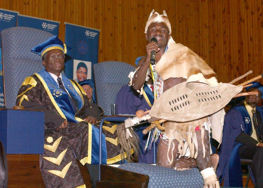
The Chief Justice of the Republic of South Africa, Pius Langa, was appointed as the first Chancellor of Nelson Mandela Metropolitan University
Chief Justice Pius Nkonzo Langa was born in the Eastern Transvaal on 25 March 1939. He matriculated through private study in 1960. He obtained his B Iuris from the University of South Africa in 1973 and his LLB in 1976.
He worked in a shirt factory from 1957 to 1960 but then found employment as an interpreter and messenger for the Department of Justice. He worked his way up to serving as a prosecutor and then magistrate.
He continued to study until he resigned from the department in April 1977 and was admitted as an advocate of the Supreme Court in Natal in June 1977. He practised at the Durban Bar and became senior counsel in January 1994.
As an advocate, his work involved both civil and criminal matters with a predominance of political trials. He appeared in most of the more significant political trials - mostly in Natal, the Eastern Cape and the Western Cape. His practice reflected the struggle against apartheid and his clientele included the underprivileged, civic bodies, trade unions and people charged under security legislation and the so-called “crimes against the state”.
Justice Langa was a member of the Democratic Lawyers Association and served on its executive. In 1987 he served on the steering committee that preceded the formation of the National Association of Democratic Lawyers (Nadel); he became a founder member of Nadel and served as its president from 1988 until his resignation in 1994.
He was appointed Justice of the Constitutional Court of the Republic of South Africa in October 1994, became Deputy President of the Court in August 1997 and was appointed Deputy Chief Justice of the Republic in November 2001. On 1 June 2005, he assumed the position of Chief Justice.
He has been awarded honorary Doctor of Law degrees by the University of Zululand, the University of the Western Cape and the University of Cape Town. He was appointed honorary professor in the department of procedural and criminal law at the University of Natal in June 1998 and has served as the distinguished visiting professor at the Southern Methodist University in Dallas, in the United States. In October 1998 he was installed as the chancellor of the University of Natal.
The appointment of the chancellor by NMMU Council was a preceded by a process where members of the Council and Institutional Forum were invited to submit nominations for the office of chancellor in accordance with laid down criteria. The Council made this appointment on the advice of the Institutional Forum which is representative of all NMMU’s constituencies.
Judge Ronnie Pillay, Chair of the NMMU Council, said Justice Langa has always been involved in attempts to improve the quality of life of his fellow South Africans. He has helped organise civic organisations and townships residents' associations, and has given guidance to youth and recreational clubs. In so doing, he has become known for his objective approach to life and enhancing the non-discriminatory ethic.
Judge Langa passed away in July 2013.