


Page 19 - Transformation Report
P. 19
2.2    Flexible, Blended Learning Pathways
            The pandemic provided an opportunity to develop blended learning and flexible learning pathways, thus enabling students
            to elect to continue their studies at a pace that would ensure their academic success. Each learning pathway was designed
            to provide students with equivalent learning content and assessment, regardless of the elected learning pathway. In support
            of blended learning, all LT development programmes for students and staff were migrated onto online platforms namely,
            Moodle, MS Teams, Zoom, and WhatsApp.


            A further innovation initiated by the LT Collab was the facilitation of iingxoxo to provide opportunities for academic staff to
            critically reflect on how to adapt their pedagogical approaches to promote student success in a blended learning context. The
            explicit inclusion of the student voice in these dialogues was particularly encouraging since it cultivated inclusive practices at
            all levels. Students have expressed appreciation for the various learning resources shared by their lecturers, while also surfacing
            some of the challenges experienced, such as the coverage of large volumes of content in a short space of time, as well as too
            many assessment activities across various modules.


            2.3    Digitalisation of Learning and Teaching - Learning Management System
            Shifting to blended and flexible learning pathways at the scale required a Learning Management System (LMS) that hosts
            learning content while also providing a platform for discussion. Expanded access to e-learning resources was facilitated via the
            use of the University’s Moodle LMS which has increased exponentially across all faculties with 4 881 modules now available
            online. In the first quarter of 2020, there were approximately 1 500 lecturers using 5 674 Moodle sites on the Moodle LMS. This
            augurs well in terms of the drive to accelerate the digitalisation of learning and teaching. Given that there was an unacceptably
            high number of students with limited access to mobile devices and connectivity at the start of the March 2020 Lockdown, the
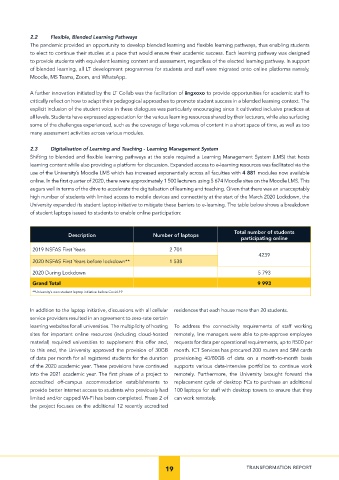
            University expanded its student laptop initiative to mitigate these barriers to e-learning. The table below shows a breakdown
            of student laptops issued to students to enable online participation:


                                                                                   Total number of students
                         Description                   Number of laptops
                                                                                      participating online
            2019 NSFAS First Years                           2 701
                                                                                            4239
            2020 NSFAS First Years before lockdown**         1 538
            2020 During Lockdown                                                            5 793

            Grand Total                                                                    9 993
            **University’s own student laptop initiative before Covid-19

            In addition to the laptop initiative, discussions with all cellular  residences that each house more than 20 students.
            service providers resulted in an agreement to zero-rate certain
            learning websites for all universities. The multiplicity of hosting  To address the connectivity requirements of staff working
            sites for important online resources (including cloud-hosted  remotely, line managers were able to pre-approve employee
            material)  required  universities  to  supplement  this  offer  and,  requests for data per operational requirements, up to R500 per
            to this end, the University approved the provision of 30GB  month. ICT Services has procured 200 routers and SIM cards
            of data per month for all registered students for the duration  provisioning 40/80GB of data on a month-to-month basis
            of the 2020 academic year. These provisions have continued  supports various data-intensive portfolios to continue work
            into the 2021 academic year. The first phase of a project to  remotely. Furthermore, the University brought forward the
            accredited off-campus accommodation establishments to  replacement cycle of desktop PCs to purchase an additional
            provide better internet access to students who previously had  100 laptops for staff with desktop towers to ensure that they
            limited and/or capped Wi-Fi has been completed. Phase 2 of  can work remotely.
            the project focuses on the additional 12 recently accredited


                                                           19                           TRANSFORMATION REPORT

