


Page 40 - Transformation Report
P. 40
prone to experience challenges, such as transportation limitations, poor internet connectivity, and food security issues. We
           therefore actively sought to select peer helpers from the accredited off-campus accommodation spaces, given the unique
           challenges that these students are confronted with. Peer Helpers selected and trained in 2020 are mentored by the psychologist
           who coordinates the programme.

           8.3     Career Construction and Employability
           Emthonjeni Student Wellness continues to maintain engagement with our current students via digital platforms and offers career
           exploration to those considering course changes. Our team created materials for the newly developed MyFuture@Mandela
           website and maintained engagement with parents and prospective students via digital platforms, providing information to
           support students’ career exploration and post-secondary educational opportunities. MyFuture@Mandela was undertaken in
           collaboration with the Student Recruitment and Marketing team. During the Virtual Career Exhibition, we launched an ESW
           chatroom in collaboration with the World of Work Exhibition team.

             9.  Integrated Financial Aid, Scholarship and Bursary Administrative Processes, and Systems

           To ensure access for academically deserving, financially needy students, Management and the SRC meet on an annual basis
           to discuss, review, and agree to the financial concessions to be implemented for that specific year. These concessions are then
           approved by MANCO after which the Financial Aid Task Team oversee the implementation of these financial concessions.
           Periodically, the task team will highlight emerging trends in the cases they deal with, which may require further consideration
           as part of the ongoing concession review process. To integrate the student bursary and scholarship processes, the Bursaries
           and Scholarship Committee membership and role were amended in December 2020.

           9.1     NSFAS – funding /process / administration
           It must be noted that 47% of Mandela University graduates at undergraduate level received NSFAS funding for their first
           qualification, but this support only extends as far as the first qualification. In 2018 NSFAS, in collaboration with AdaptIT,
           provided an electronic integration between ITS and the NSFAS database. This has been implemented on the University
           production servers and allowed the Financial Aid Department to query the NSFAS status of a student, as well as to electronically
           pull and upload NSFAS information into ITS. In December 2020, the Institutional Fund Administration Agreement was signed
           with NSFAS. All NSFAS and postgraduate students continue to be paid allowances and, by the third quarter of 2020, the
           University has administered R1 274 627 706 for student financial aid. In January 2020, the University signed a Memorandum of
           Agreement with NSFAS. Further NSFAS System Enhancements were implemented to:
           •       allow successful NSFAS applicants to register on time
           •       include the identification of continuing NSFAS students
           •       indicate whether the students still qualify for funding based on the NSFAS progression rules
           •       reversals against students who have de-registered
           •       modifications to the Financial Aid Web application to identify students qualifying for concessions

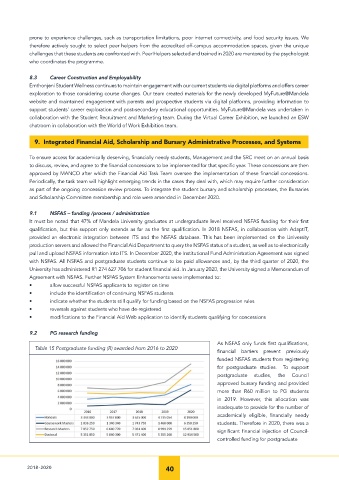
           9.2     PG research funding

                                                                             As NSFAS only funds first qualifications,
             Table 15 Postgraduate funding (R) awarded from 2016 to 2020
                                                                             financial  barriers  prevent  previously
                                                                             funded NSFAS students from registering
                                                                             for postgraduate studies.  To support
                                                                             postgraduate  studies,  the  Council
                                                                             approved bursary funding and provided
                                                                             more than R60 million to PG students
                                                                             in  2019.  However,  this  allocation was
                                                                             inadequate to provide for the number of
                                                                             academically  eligible,  financially  needy
                                                                             students. Therefore in 2020, there was a
                                                                             significant financial injection of Council-
                                                                             controlled funding for postgraduate


           2018-2020                                       40

