


Page 60 - Transformation Report
P. 60
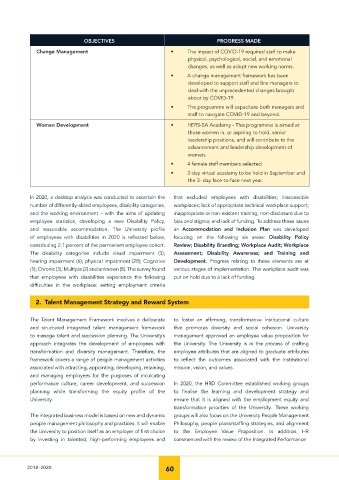
OBJECTIVES                                    PROGRESS MADE

              Change Management                              •     The impact of COVID-19 required staff to make
                                                                         physical, psychological, social, and emotional
                                                                         changes, as well as adopt new working norms.
                                                             •     A change management framework has been
                                                                         developed to support staff and line managers to
                                                                         deal with the unprecedented changes brought
                                                                         about by COVID-19.
                                                             •     The programme will capacitate both managers and
                                                                         staff to navigate COVID-19 and beyond.

              Women Development                              •     HERS-SA Academy - This programme is aimed at
                                                                         those women in, or aspiring to hold, senior
                                                                         leadership positions, and will contribute to the
                                                                         advancement and leadership development of
                                                                         women.
                                                             •     4 female staff members selected
                                                             •     2-day virtual academy to be held in September and
                                                                         the 3- day face-to-face next year.

            In 2020, a desktop analysis was conducted to ascertain the   that  excluded employees  with  disabilities;  inaccessible
            number of differently-abled employees, disability categories,   workplaces; lack of appropriate technical workplace support;
            and the working environment – with the aims of updating   inappropriate or non-existent training; non-disclosure due to
            employee  statistics,  developing  a  new  Disability  Policy,   bias and stigma; and lack of funding. To address these issues
            and  reasonable  accommodation.  The  University  profile   an  Accommodation and Inclusion Plan was developed
            of  employees  with  disabilities  in  2020  is  reflected  below,   focusing on the following six areas:  Disability Policy
            constituting 2.1 percent of the permanent employee cohort.   Review; Disability Branding; Workplace Audit; Workplace
            The disability categories include visual impairment (3);   Assessment; Disability Awareness; and Training and
            hearing impairment (6); physical impairment (28); Cognitive   Development.  Progress  relating to  these  elements  are  at
            (1); Chronic (3); Multiple (2) and unknown (8). The survey found   various stages of implementation. The workplace audit was
            that employees with disabilities experience the following   put on hold due to a lack of funding.
            difficulties  in  the  workplace:  setting  employment  criteria


              2.  Talent Management Strategy and Reward System

            The  Talent  Management  Framework  involves  a  deliberate   to  foster  an  affirming,  transformative  institutional  culture
            and structured integrated talent management framework   that promotes diversity and social cohesion. University
            to manage talent and succession planning. The University’s   management approved an employee value proposition for
            approach integrates the development of employees with   the  University.  The  University  is  in the process  of  crafting
            transformation and diversity management. Therefore, the   employee attributes that are aligned to graduate attributes
            framework covers a range of people management activities   to  reflect  the  outcomes  associated  with  the  Institutional
            associated with attracting, appointing, developing, retaining,   mission, vision, and values.
            and managing employees for the purposes of inculcating
            performance  culture, career  development, and succession   In 2020, the HRD Committee established working groups
            planning  while  transforming  the  equity  profile  of  the   to  finalise  the  learning  and  development  strategy  and
            University.                                       ensure that it is aligned with the employment equity and
                                                              transformation priorities of the University. These working
            The integrated business model is based on new and dynamic   groups will also focus on the University People Management
            people management philosophy and practices. It will enable   Philosophy, people plans/staffing strategies, and alignment
            the University to position itself as an employer of first choice   to the Employee Value Proposition. In addition, HR
            by investing in talented, high-performing employees and   commenced with the review of the Integrated Performance


           2018-2020                                       60

