


Page 27 - Transformation Report
P. 27
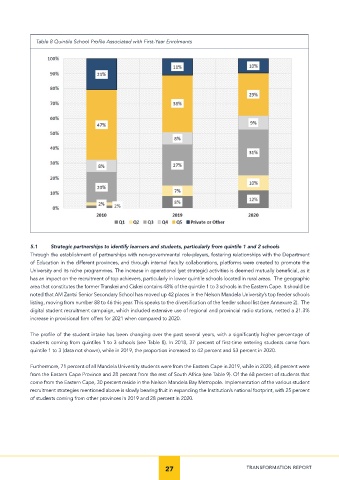
Table 8 Quintile School Profile Associated with First-Year Enrolments


            5.1    Strategic partnerships to identify learners and students, particularly from quintile 1 and 2 schools
            Through the establishment of partnerships with non-governmental role-players, fostering relationships with the Department
            of Education in the different provinces, and through internal faculty collaborations, platforms were created to promote the
            University and its niche programmes. The increase in operational (yet strategic) activities is deemed mutually beneficial, as it
            has an impact on the recruitment of top achievers, particularly in lower quintile schools located in rural areas.  The geographic
            area that constitutes the former Transkei and Ciskei contains 48% of the quintile 1 to 3 schools in the Eastern Cape. It should be
            noted that AM Zantsi Senior Secondary School has moved up 42 places in the Nelson Mandela University’s top feeder schools
            listing, moving from number 88 to 46 this year. This speaks to the diversification of the feeder school list (see Annexure 2).  The
            digital student recruitment campaign, which included extensive use of regional and provincial radio stations, netted a 21.3%
            increase in provisional firm offers for 2021 when compared to 2020.


            The profile of the student intake has been changing over the past several years, with a significantly higher percentage of
            students coming from quintiles 1 to 3 schools (see Table 8). In 2018, 37 percent of first-time entering students came from
            quintile 1 to 3 (data not shown), while in 2019, the proportion increased to 42 percent and 53 percent in 2020.


            Furthermore, 71 percent of all Mandela University students were from the Eastern Cape in 2019, while in 2020, 68 percent were
            from the Eastern Cape Province and 28 percent from the rest of South Africa (see Table 9). Of the 68 percent of students that
            come from the Eastern Cape, 30 percent reside in the Nelson Mandela Bay Metropole. Implementation of the various student
            recruitment strategies mentioned above is slowly bearing fruit in expanding the Institution’s national footprint, with 25 percent
            of students coming from other provinces in 2019 and 28 percent in 2020.


                                                           27                           TRANSFORMATION REPORT

